Molycop et l'Université Queen Mary de Londres font progresser la recherche sur les médias de broyage grâce à la modélisation prédictive, contribuant ainsi à améliorer la constance de la production, les performances des produits et la durabilité. Ces recherches collaboratives seront présentées lors de la conférence PRICM12 qui se tiendra sur la Gold Coast en août 2026.
Key Facts
- Research uses advanced modelling to predict thermal and microstructural changes in grinding media.
- Experimental validation confirmed strong agreement between model predictions and laboratory results.
- Findings will be presented at PRICM12 on the Gold Coast in August 2026.
The paper, titled “Modelling and Prediction of Thermal Field and Microstructural Evolution During Processing of Steel Grinding Media,” brings together researchers from QMUL and Molycop to explore how advanced modelling techniques can improve the design and manufacture of steel grinding media.
The work represents an important step towards more predictive, data-driven manufacturing processes that can enhance grinding media performance while supporting greater efficiency and sustainability across the mining industry.
.png)
Understanding What Happens Inside a Grinding Ball
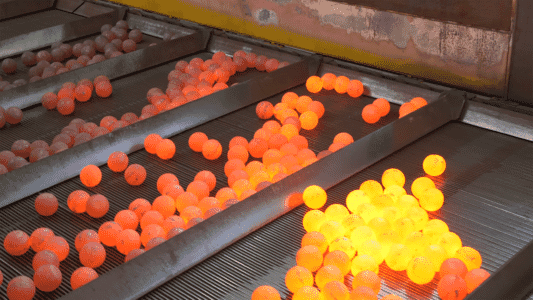
Steel grinding media plays a critical role in mineral processing, helping reduce ore particle size and liberate valuable minerals. However, grinding media consumption remains one of the largest operating costs for many processing plants, accounting for an estimated 30 per cent of overall operational expenditure.The performance and service life of grinding media are heavily influenced by their final microstructure, which is formed during heat treatment. Achieving consistent microstructures throughout a grinding ball is particularly challenging due to the temperature differences that occur between the surface and core during processing.
These variations can significantly influence hardness, wear resistance and overall performance in operation.
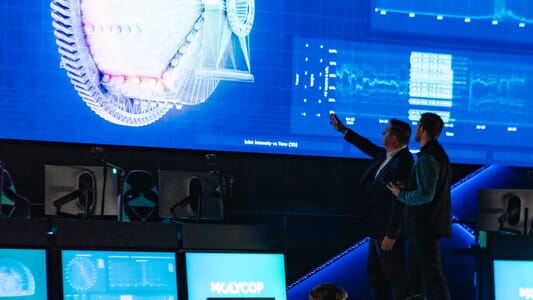
To better understand and predict these effects, the research team developed an advanced modelling framework capable of simulating how temperature evolves throughout the grinding media during heat treatment.
Combining Metallurgy and Advanced Simulation
The study uses a finite element modelling (FEM) approach to predict the thermal history of steel grinding media as they move through different stages of processing.The model goes beyond simple temperature prediction by incorporating a specialised user-material subroutine that links thermal history to metallurgical transformations. This enables the researchers to predict not only temperature distribution throughout the grinding media, but also the resulting microstructures and hardness profiles that develop during cooling.
By understanding how microstructures evolve from the surface to the core, manufacturers can gain deeper insights into the relationship between processing parameters and final product performance. Dr Hamid Pourasiabi - Principal Tribology/Metallurgy Engineer – Innovation at Molycop and co-author of the paper says:
This work is about understanding and predicting how processing influences the final properties of grinding media. By combining computational modelling with experimental validation, we can develop tools that help optimise manufacturing processes and ultimately produce more consistent, higher-performing products.
-(1).jpg)
Validating the Model
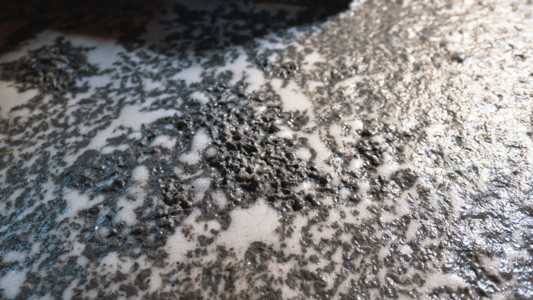
A key component of the research was rigorous experimental validation.Grinding media samples of the same composition were characterised using a range of advanced metallurgical techniques, including optical microscopy, scanning electron microscopy (SEM), X-ray diffraction and hardness testing.
The experimental results were then compared with the model predictions, allowing the team to assess how accurately the framework could capture the thermal and microstructural evolution occurring during processing.
The strong agreement between prediction and observation demonstrates the potential of the modelling approach as a powerful tool for understanding and optimising heat treatment processes.
Supporting Innovation and Sustainability
While the research focuses on fundamental metallurgical science, its implications extend far beyond the laboratory.Longer-lasting, higher-performing grinding media can contribute to improved comminution efficiency, reduced media consumption and lower operating costs for mining companies. Reducing grinding media replacement rates can also help lower the environmental footprint associated with manufacturing, transportation and resource consumption.
As the mining industry continues to focus on operational efficiency and sustainability, predictive tools such as these offer new opportunities to optimise products before they are deployed in the field.
The project also reflects Molycop's broader commitment to combining metallurgical expertise, academic collaboration and advanced digital technologies to drive innovation across the business.
.jpg)
Sharing Research at PRICM12
The findings will be presented at PRICM12, one of the world's premier conferences focused on advanced materials and processing.Held every three years, PRICM brings together scientists, engineers and researchers from across the Asia-Pacific region and beyond to share advances in materials science, manufacturing and engineering. Jointly sponsored by leading professional organisations from Australia, China, Japan, Korea and the United States, the conference is recognised as a leading forum for international collaboration and innovation.
The 2026 program covers a wide range of topics, including advanced steels, additive manufacturing, energy materials and artificial intelligence in materials modelling—making it an ideal platform for showcasing research that bridges computational modelling and practical industrial applications.
For Molycop, participation in PRICM12 highlights the company's continuing investment in research partnerships that advance the science behind grinding media performance and support better outcomes for customers worldwide.
Paper Details
Title: Modelling and Prediction of Thermal Field and Microstructural Evolution During Processing of Steel Grinding MediaAuthors:
- Rajdeep Mondal
- Hamid Pourasiabi
- Chinnapat Panwisawas
- H.K.D.H. Bhadeshia
Date: 9–13 August 2026
Location: Gold Coast, Australia