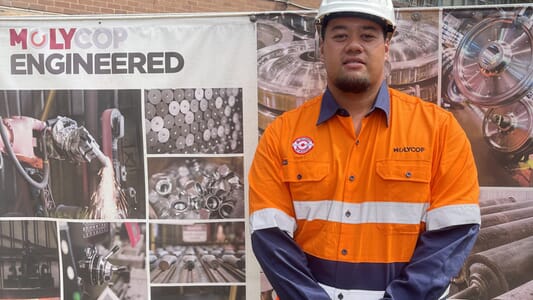
As a Metallurgical Laboratory Engineer at Molycop’s Indonesia Wear Research Lab, Syaiful Bachri combines practical steelmaking experience with advanced wear testing to support product development and improve customer outcomes.
Key Facts
- Supports grinding media innovation through wear testing and research.
- Uses BMAT testing to analyse wear performance and product quality.
- Helped identify and resolve HiCr grinding media fracture issues.
Today, as a Metallurgical Laboratory Engineer at Molycop’s Indonesia Wear Research Lab, he is combining his background in steel manufacturing with advanced wear testing to help improve grinding media performance, support product development and deliver better outcomes for customers.
His journey began at Institut Teknologi Bandung (ITB), where he studied Metallurgical Engineering. For his final-year project, Syaiful developed a steel alloy for high-temperature boiler applications, taking it from raw materials through melting, heat treatment and microscopic analysis. He says:
That project taught me how changes in microstructure directly affect material performance. It gave me a strong foundation that still supports the work I do today.
After graduating, Syaiful spent six years in Indonesia’s steel industry, working across process optimisation and quality control. He gained hands-on experience throughout the steelmaking process, from refining to continuous casting, while tackling challenges such as reducing impurities, optimising alloy additions and managing product quality.
Just as importantly, the role taught him to balance technical performance with practical business realities.
Manufacturing is about making the right decisions every day. You need to understand the science, but you also need solutions that work in practice.
That practical mindset is one of the reasons he was drawn to Molycop.
Moving from steelmaking into research and development offered an opportunity to work on a different challenge: improving the product itself. Rather than focusing solely on process performance, Syaiful could explore the factors that influence grinding media wear resistance and investigate ways to enhance performance through innovation. He says:
Research allows you to ask deeper questions. What is driving wear? How does microstructure influence performance? Where can we improve? Those are the questions that excite me.
Investigating wear through BMAT testing
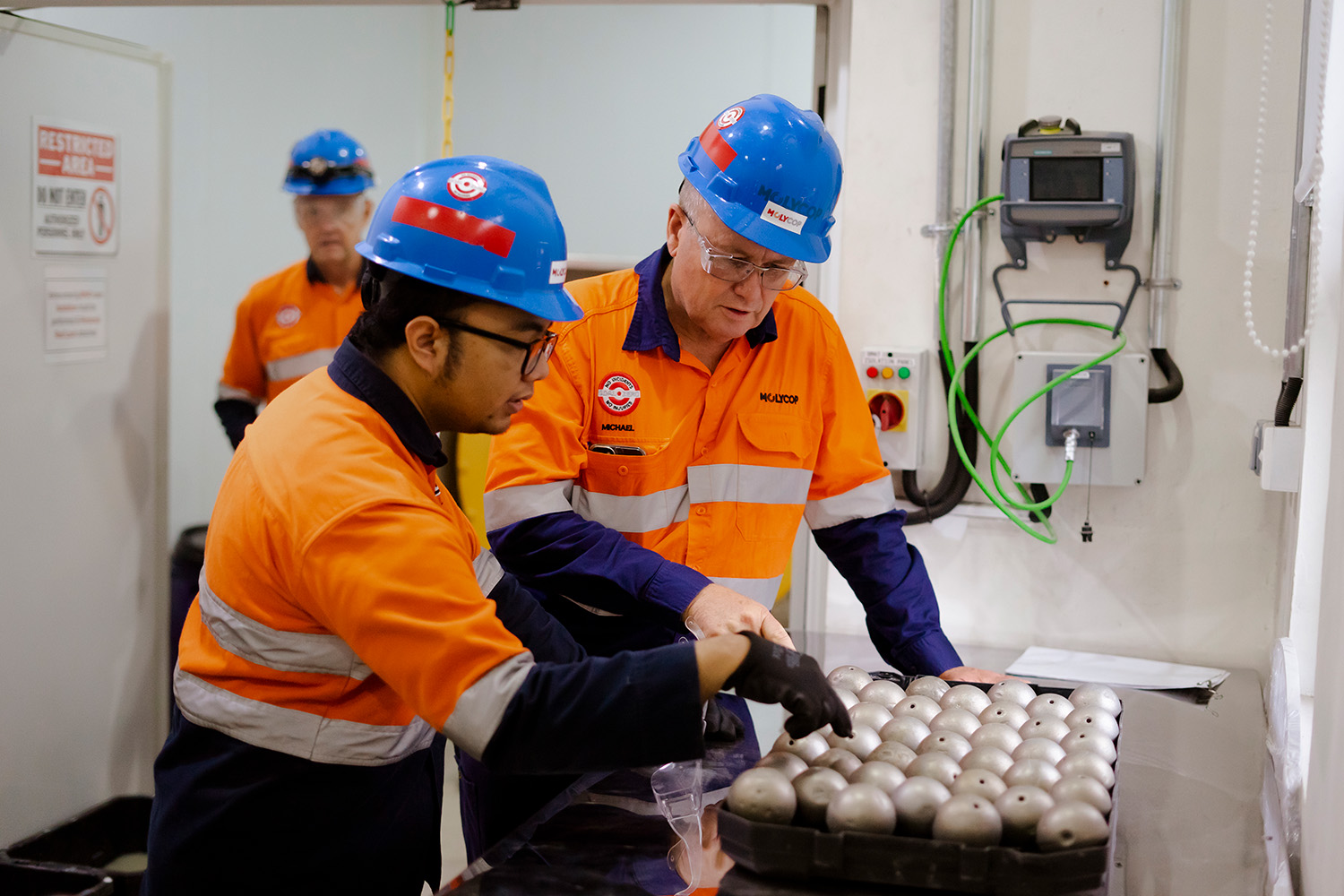
At the heart of his work today is the Ball Mill Abrasion Test (BMAT), a controlled testing method that simulates how grinding media perform inside operating mills. The test provides valuable insights into wear behaviour under conditions that closely reflect real-world applications.For Syaiful, the most rewarding part of the role is the investigation behind the data. He says:
Every wear result tells a story. You can trace performance back to surface quality, microstructure, heat treatment or chemical composition. Understanding those relationships helps us develop better products.
His work has already contributed to meaningful improvements. During early BMAT testing on high chrome cast iron (HiCr) grinding media, the laboratory successfully replicated fracture issues that had been observed in the field. Those findings helped inform process changes that improved product quality.
“Syaiful brings a unique combination of metallurgical expertise, practical manufacturing experience and genuine curiosity,” says Hamid Pourasiabi, Principal Tribology/Metallurgy Engineer – Innovation. “His ability to connect laboratory insights with real-world performance is helping us strengthen product development and deliver better outcomes for customers.”
It started as a laboratory observation. But it ultimately led to a better product for our customers.
.jpg)
Exploring the future of wear research
As customer demand for HiCr grinding media continues to grow, Syaiful and the Indonesia Wear Research Lab are playing an increasingly important role in validating product performance and supporting innovation across the business.Looking ahead, he is particularly interested in unlocking deeper insights into wear behaviour by combining metallurgical expertise with data-driven technologies.
One area that excites him is the potential to use BMAT data alongside machine learning. By building a comprehensive database of wear results across different grinding media grades, mill conditions and ore types, he believes Molycop could create predictive tools that help customers identify the best product for their specific operating conditions.
“The goal is to better understand the connection between microstructure, chemistry, ore characteristics and wear performance,” he says. “If we can do that, we can make more precise recommendations and develop even better solutions for our customers.”
.jpg)
Driven by curiosity on and off the job
Outside the laboratory, Syaiful enjoys exploring Indonesia’s diverse natural landscapes and pursuing his passion for landscape photography. Whether in the mountains, forests or along the coast, photography allows him to slow down, observe and appreciate details that others might miss.It’s an approach that mirrors his work as a researcher: staying curious, looking closely and continually searching for new insights.
For Syaiful, that curiosity continues to drive his work every day—transforming data into knowledge, knowledge into innovation and innovation into better outcomes for Molycop’s customers.